Reflections on EGU26
EGU26 finished with a blast, perhaps ideal as we were celebrating 20 years in Vienna, and can be perfectly summarised oxymoronically as an exhausting, energising week.
The European Geosciences Union (EGU) is the largest meeting for those in the geosciences (~22,500) held annually in Vienna, Austria, Europe. Since I can almost be regarded as a regular, here are my thoughts from this year.
Please note that these are my opinions and may not reflect those of my institution, funders, or managers.
Contents
Vienna city sign
Reflections and highlights
EGU is intense - sessions start at 8:30am and run until 6pm (followed by beers) each day. There are countless parallel tracks spread across 4 floors and 4 poster halls of the Vienna International Centre. As such it was impossible to see everything, but these are the impressions I came away with from what I did see.
ECMWF
My week began Monday 8:30am with a staple of the conference that I always enjoy: Updates from ECMWF on the latest developments in their forecasting systems . With an interest in better streamlining research to operations, it’s always interesting to hear what has finally propagated into leading operational forecasting. Key takeaways this year were:
- Further use of single precision in some places in the model physics, cutting computational costs by up to 40%!
- A lot of Machine learning (ML), but with a focus on emulation and data driven forecasts rather than hybrid modelling. I’d had the feeling from the community that ECMWF were less interested in hybrid models in recent years, and indeed they note that they are now working to move towards end-to-end observation -> forecast operation.
- On a related note, based on the scorecards, there’s now no argument that AIFS, as a black-box forecast is the clear winner. However, I maintain this is just because we get “real-time data assimilation”, and the physical models still hold value, which brings us nicely to my next point.
- ERA6 is coming (I’m sure this was in the EGU25 update…) with the main selling point being 14km resolution, opening the door for training of higher resolution models.
It was an ECMWF-heavy day as I followed this up with a walkthrough on using the new MARS (Meteorological Archival and Retrieval System) data portal for ECMWF data. I’ve noticed that our team at work often gets queries from researchers for help in accessing and managing climate data, especially ERA5, and we are somewhat underskilled on this front. Unfortunately my current ECMWF account did not have full permissions for the session, but I’ve since upgraded it and hope to run through the materials again, eventually disseminating the knowledge to the team.
The biggest surprise of the session was running into my old BAS colleague who left shortly after me to become an RSE at ECMWF and now works on MARS! It was great to catch up with her and hear what it’s like working in their software teams. I had a good lunch with the ECMWF software engineers who confirmed that there was a focus on AI over hybrid modelling and that observation to forecast is what they are chasing, including the bold statement “Data assimilation will be obsolete soon!”. I’m not sure I agree, but let’s see what the next year brings.
AI and ML
Whether you are a fan of AI, or not, or still on the fence, my first general observation about EGU26 is that it was impossible to avoid. There has been an explosion in “AI/ML” sessions, but even non-AI sessions feature it, with everyone wanting to note that they are in some way tied. Further, the parlance has shifted, perhaps driven by the wider world, for it to now be “AI” rather than “ML”, even when used in a physics-based talk/model.
The end of Monday brought two of my standout talks for this year. I love a simple idea that illustrates something interesting, and this is what Maren Hover did in Spatial Generalization Tests for Machine Learning-based Weather Models as a Requirement for Climate Predictions . They explored exactly how and what climate emulators have learnt by running them on planets with transposed coordinate systems. The simplest example was a simple 180 rotation longitude. We’d hope that the model can pick up on this as simply introducing a phase lag in time, with the diurnal cycle driven only by incoming solar radiation, but instead we see that it has learnt diurnal correlation to datetime. Similar experiments are performed with reflections in latitude and longitude whereby we see “ghost mountains” appear over the ocean where the Himalaya once were. I liked this talk for a few reasons; not only was it a simple idea, but it also raises an interesting question about black-box accuracy vs. physical consistency of these models, and was delivered extremely well.
The second talk I enjoyed was How Organized Convection Evolves in Latent Space by Sophie Abramian. This was not as simple, but it was elegant and again well-presented. Transition between convective regimes is complicated and highly non-linear. They run SAM for 30 days with low-level shear, transforming to a latent space with the Koopman operator to try and recover linear behaviour. By performing clustering for different convective regimes in this space and then PCA between cluster centroids they identify regime transitions that can be represented in a single transition matrix/Markov chain.
Generative AI
As expected, there was more discussion of Generative AI this year, including a dedicated session. I attended this and was disappointed - most talks boiled down to vibe-coded apps for data analysis, or RAG layers to interact with publications. The only interesting talk to me was an educational study on how students were using GenAI in their work, with conclusions:
- 100% of students are using genAI,
- though not all feel good about it and some feel pressured to do so.
- It’s unclear what is student and what is AI work in assessment.
- Fieldwork and lab work is where AI helps least,
- and less use of AI correlated with better retention of knowledge.
- Oral is becoming the most robust method of assessment.
Interestingly absent from (almost) all discussion I was in was the topic of AI generated code. People are definitely using it, but there still feels to be a stigma attached amongst (many) academics. The only lengthy discussion I had was with Milan about setting up his Claude-bot for Speedy. We agreed on the principles of only assigning boring tasks you already know how to do, thoroughly reviewing results, and preparing for a future where we need to be far more selective in what we outsource. I should also mention that part of our taught course (see below) included a discussion of coding with AI (thanks to Karolina) though most questions from the participants still tackled traditional software/coding questions suggesting GenAI isn’t yet a silver bullet in this space.
FAIR and TCTrack
Tuesday was a busy day for me as I had my poster in the morning and was convening a session in the afternoon. The poster was in the tropical cyclones session, a PhD throwback for me, showcasing our tracking code TCTrack that provides easy access to cyclone tracking algorithms and FAIR output data based on the CF-Conventions . I was apprehensive as we show no “new research”, but it turned out to be very popular with a lot of discussions around FAIR data and making software easier to use. It was nice to be reassured that the work of the RSE really is tackling issues researchers struggle with, with better software giving them tools to do better research.
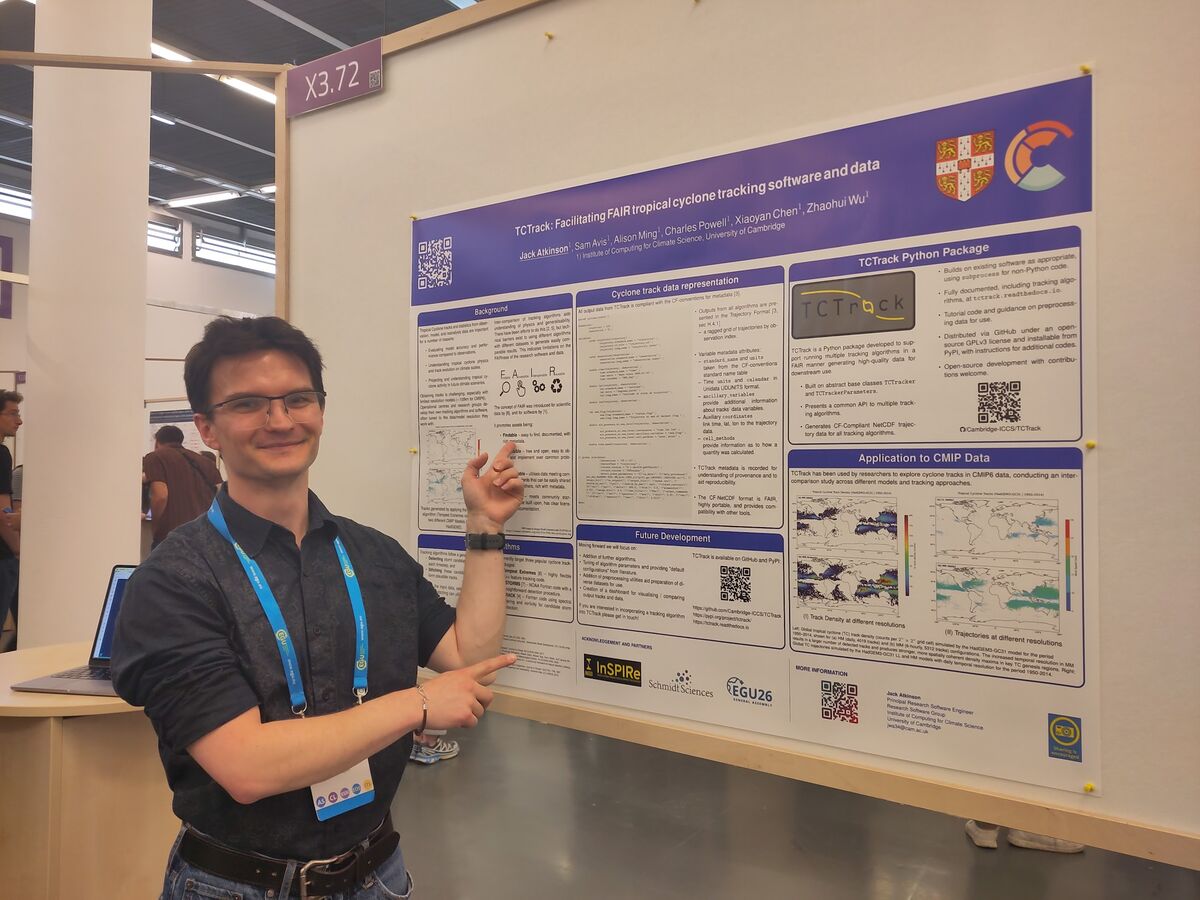
TCTrack poster at EGU26
I had good discussions with the developer of Hurucanpy about open-source tools in the domain, numerous people interested in using TCTrack to detect extratropical storms that do not appear in the IBTrACS dataset, and received suggestions for how to make the tool more useful to others in the domain.
This interest in FAIR carried through to the sessions I attended specifically on this topic. I particularly enjoyed Kelsey Druken’s talk Scaling FAIR Data Practices in Climate Modelling that emphasised the need to embed FAIR into tools as much as we can to reduce manual burden on users for whom it is often an afterthought. This resonates well with our work on TCTrack and was echoed in Incentivising open science through powerful free and open tooling .
Also interesting was Berlin librarian Andreas Hübner’s talk Using “Data Agreements” in universities to clarify research data rights of use where he described how they draw up clear agreements at the start of all projects to define who owns what data and what they can do with it. Answering questions like: who can share the data, who can take the data, where to publish the data, how to collaborate with the data? The rest of the session highlighted several other initiatives and tools that I am keen to explore further, including SciX and GeoFAIR , and introduced me to a counterpart of FAIR, CARE:
- Collective benefit
- The data should be used for equitable outcomes for all involved
- Authority to control
- Recognise people’s rights to the data and allow them governance
- Responsible
- Use the data for good,
- Ethical
- Minimise harm and maximise benefit. Bring justice, now and for the future.
which is especially applied to data gathered with and from indigenous cultures.
Our hybrid modelling session
For the third year running I convened a session on Advancing Earth System Models using Machine Learning with Oxford’s Laura Mansfield, this year joined by Milan Klöwer and Alex Connolly.
Unlike some other sessions we are fairly selective, redirecting talks to other places if we feel they’d be a better fit for the speaker/audience. What results is a well curated series of talks and posters that was (almost) “all killer and no filler”, reflected by a packed-out, standing room only session all the way to 6pm.
We began with our invited speaker Arthur Grunder who gave a fantastic talk showing how symbolic regression can find a sweet-spot between traditional methods and parameter heavy neural-net methods. It was everything we hoped for from an emerging academic showing an alternative to the neural-net-hammer.
I also enjoyed Blanka Bolough’s talk discussing the need for having a “triggering net” in accompaniment to a “convection parameterisation” net. This relates to discussions we had with Hannah Christensen last summer (the ICCS work on YOG and Greta’s work on triggering) about how it’s not always as simple as replacing a single parameterisation in a model, especially when it’s not a direct emulator, as they replace something with complex dependencies on, and tuned to work specifically with, the other parametrisations in the model.
The session finished with a wonderful (as always) and thought-provoking talk from Tom Beucler where he sought to draw some “apples-to-oranges” comparisons between traditional numerical climate models and AI emulators.[^if that’s still the right word, I feel we’re beyond simple emulation now.]
It’s been fantastic organising this session with Laura over the years, and I’m sad that this will likely be the last as she moves on. At the same time I feel hybrid modelling is beginning to feel a little “run of the mill”, like downscaling did a couple of years ago, so I’m interested in targeting something a little different next year; I had a few discussions at EGU26 on what this might be, so watch this space!
Data
Returning to the themes of TCTrack, FAIR, and MARS there was a lot of content on data again this year. This is something I believe we could be stronger in; whilst there are data specialists and software specialists amongst research technical professionals, I feel that the field of climate science generates such large quantities and varieties of data that we can’t escape needing knowledge of how and why to store things.
Sticking with this, it’s clear from sessions this year that all the cool kids are using Zarr. My impression from speaking to people is that this is likely driven by Xarray usage. The main selling point seems to be speed as a result of having more easily manipulatable (i.e. chunked) data – also a benefit for ML. New codes I saw are often being written with Zarr-first. It’s worth remembering that there is a NetCDF backend for Zarr, perhaps this will see increasing usage - though I’ve never tried using it from C/Fortran myself yet…
NetCDF isn’t dead to king Zarr however, and there were a couple of posters worth mentioning.
First was from
NCAS on pyfive
.
I saw this work announced in September and didn’t quite
get it, but it’s gradually making more sense. They’ve built a pure-Python HDF5 reader
that removed the thread-locking of the regular C library to increase speed. Perhaps
more interesting to me (as I’ve
recently been thinking about NetCDF file packing
)
was their NetCDF repacking tool. When you write NetCDF from a simulation one timestep at
a time the HDF5 binary tree can end up very inefficient with metadata scattered across the file.
NCAS have a tool (
cmip7-repack
) that will take a final NetCDF and defragment and chunk.
Repacking brings all metadata to the front and reduces request sizes, potentially cutting
access/download times by orders of magnitude.
Another cool tool worth keeping an eye on is GridLook . It provides browser-based access to analysing global datasets with a lot of neat functionality, supported grids, and driven by CF-conventions. I particularly liked the feature that allowed you to generate a link and send to someone to then open the same dataset at the same visualisation. Currently only works with Zarr (see above) but they’re working on NetCDF…
And a final mention goes to
iCSV
.
With the motivation “Have you ever found yourself looking at a text-based dataset and
being clueless what it contained?” they have made a header standard for CSV files
that allows full description of the data using the CF-conventions.
Part of me says “put it in a sensible binary format”, but another part loves the
Occam’s razor nature of the solution.
RSEs at EGU
On the Wednesday evening after sessions finished at 6pm I scheduled a popup event calling any RSE or RSE-related individuals to gather and chat. The first time I attended EGU as an RSE a similar event was organised by Daniel Nüst and was great in making me feel like I still belonged here. Following a hiatus last year I decided to keep it going, hoping someone else would turn up. In the end we had 9 people from across 5 countries there, with a highlight being when Daniel himself walked through the door to catch up. I won’t add too much more here as we’re planning a longer blog post, but it was generally great to chat, share mailing lists and slack spaces, and spread the RSE message. The only low-point was when I asked why there were so few people from the NL eScience centre compared to previous years and learnt that there had been significant cuts there.
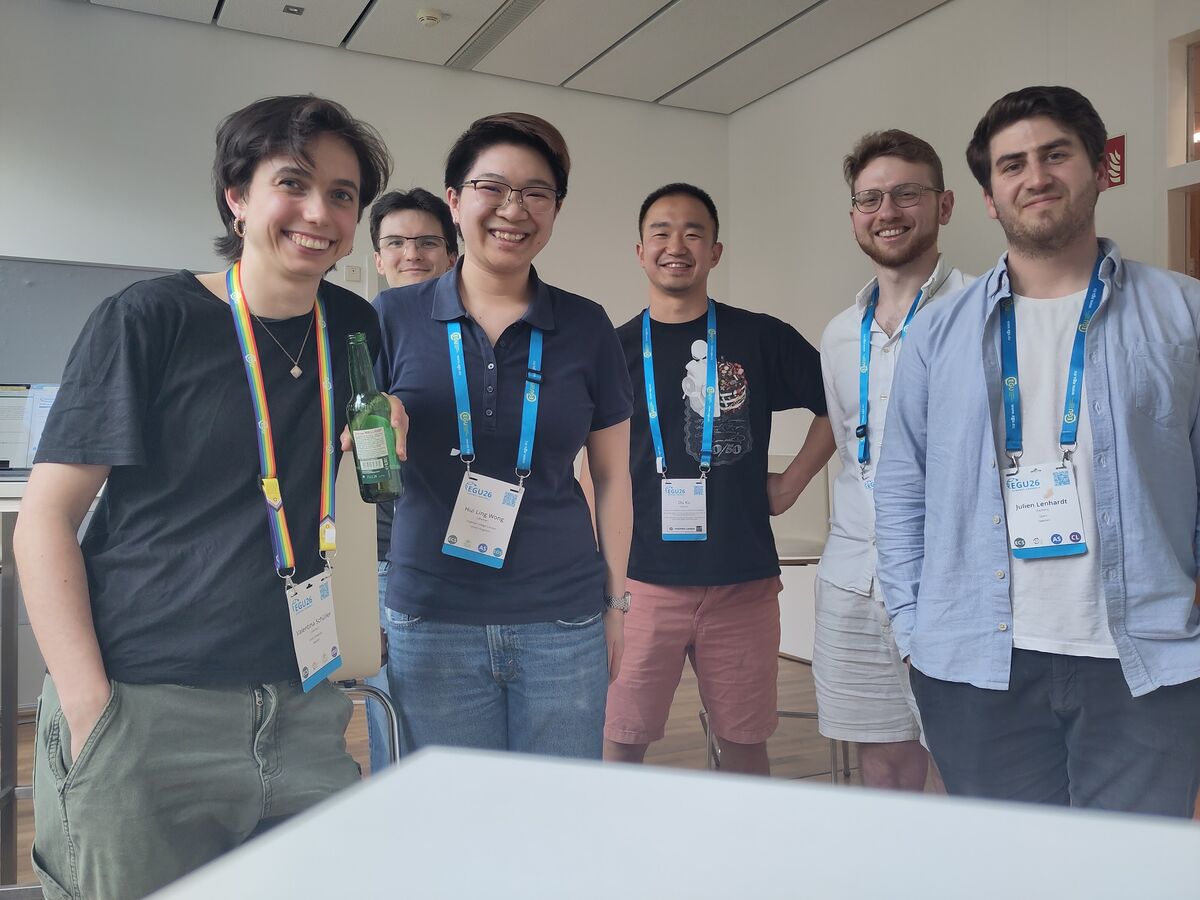
RSE meetup at EGU26
In a similar vein on the Thursday lunchtime I attended the informal Fortran meetup organised by Sebastian Mutz from Glasgow whose paper I recently edited for JOSS. Spanning the classic Fortran age range (punch-cards to PhD) there was a lot of interesting discussion about the future of the language in science, prejudices, efforts to improve collaboration, and more. Again, I’m hoping to co-write a longer blog post on this, but some immediate highlights were:
- a discussion of how Fortran can be used in teaching, and how it can be taught, and the benefits it can bring in education,
- a discussion of the wider ecosystem and efforts that are ongoing to reduce silos and build
community packages,
- Particular discussion highlights for me were discovering the fortuno testing framework and sharing the fortitude linter.
- perspectives on the language in research from late-career down to PhD students/postdocs, and academics to software developers,
Teaching
One of the great things about the scale of EGU is that it accommodates more than just presentations and posters. One of these extras is workshops and taught courses that cover a wide range of topics.
This year I proposed to teach my RSE Skills session . As there was a similar proposal from Karolina Stanisławska our sessions were combined and we worked together to adapt the material.
What we ended up with was Good Programming Practices for Research: Essential Rules for Efficient Programming . This was more of a lecture than my course, without any hands-on exercises, but based on the AV limitations at the event, and from what I heard from other sessions, this was perhaps a good thing. One thing that Karolina brought from her proposal was an open discussion session for the final 30 minutes where participants described challenges they had faced in their work and we, or others in the room, tried to provide advice, similar to ICCS’s Code Clinics . This was perhaps the best part of the session with fantastic engagement and the feeling of actually making a difference, so is something I will look to incorporate in future workshops I run.
An interesting observation was that there seemed to be a significant increase in software-focussed taught courses with this year including an Introduction to Git, Sustainable Research Software, and Reproducible Research.
Our session was scheduled in the graveyard slot (4-6pm Friday) and I was afraid all week that we’d be speaking to an empty room as people had already left the conference or took the Friday evening to relax. However, to my astonishment these fears were all in vain as we delivered the course to a packed room of around 100! This, coupled with the excellent discussion/code-clinic at the end reinforced my view that RSE remains of value with increasing interest/recognition of the importance of these aspects. Since our course contained some mention of Generative AI I hope that those present were recognising the need to improve their software- and code-literacy to be able to evaluate and trust code.
Many Meetings
One other aspect of attending a domain conference this huge is the chance to catch up with many colleagues from different walks of life.
This year I was delighted to bump into and chat with: Peter Read from Oxford AOPP with whom I did some experimental work during my PhD; Milan Klöwer also at AOPP who co-chaired with me, we had various great conversations, a standout being about his rational (in my opinion) approach to using agents in SpeedyWeather in a way that preserves scientific integrity; my old colleagues from the British Antarctic Survey, especially Tom who is now developing a new model of the radiation belts that I helped scope out before I left, and being introduced to newer members of the team; my old colleague from BAS, Jenny, who is now an RSE at ECMWF – it was interesting to hear more about how they work and meet the wider team; Daniel Nust who was my introduction to EGU as an RSE back in 2023 – we had some great discussions about how we might work to grow RSE here so watch this space next year; Shelly Stall from AGU who is here every year – As I become more interested in software and data availability and publication it is great to hear from a journal trying their best, and I hope she might give a talk in Cambridge soon; Hui Lin, one of my fellow SSI Fellows was a surprise but welcome meeting; and of course it was great to catch up with various people from across the VESRI projects, Balaji, the SASIP developers, the FETCH4 Cambridge team, and previous summer school attendees. On this last point, a particularly touching point for me was two people independently recognising me during the conference and coming to say that they previously attended our summer school and found it extremely useful in their work! Whilst this is what we aim for, it’s hard to get long-term feedback about this. I was particularly touched when they said that they appreciated the way I took a mundane subject (version control, linting, documentation) and presented it in an engaged way that made them want to care about it.
Train2EGU 4Eva
I’m a long-term advocate of #Train2EGU, as are many attendees, unsurprisingly for the domain, though the UK is definitely one of the longer trips. As usual, I’ll point people to Milan Klöwer’s 2019 study of the carbon footprint of this very conference.
Learning from mistakes of previous years I made my seat reservations early and got to feel comfortably smug during the inevitable chaos at Nürnberg as what feels like all of Europe’s geoscientists try and pack into one train.
On the train to EGU
For EGU by train I highly recommend using the interrail or eurail passes. These allow easy and cost-effective travel in Europe (especially Germany and Austria) and passage via eurostar with a seat reservation.
Bigger conclusions
As in previous years, I thought I’d draw out a few of the bigger conclusions from my attendance, particularly from a digital research/RSE perspective:
- Many talks now feature GitHub links, and more and more look like functional software
tooling. This is hopefully a step in the right direction, though I wonder if some of
this is aided by GenAI filling in traditional software engineering knowledge gaps.
- e.g. Healpix-ai
- On the subject of ML/AI this was the first time I felt like I couldn’t escape it in
any session, almost even in any poster/presentation.
At times it felt like I was at an ML conference for geoscience applications.
- However, in all of this I noted that discussion of AI coding/use in doing research was almost non-existent. This is perhaps because of stigma, but I think it raises questions about codifying good practices and ensuring research remains trustworthy. Perhaps this is an area RSEs need to engage with, as some at ICCS are already doing.
- I also note that increased LLM usage and agentic coding was not on my radar/predictions last year.
Predictions
For fun, I like to make predictions about where the field is going and what we’ll see next year. Starting with last year how did these pan out:
- It will be a big year for differentiable modelling.
- Not as big as I thought. It’s certainly being discussed, but not the revolution I’d perhaps imagined. GenAI has perhaps occupied that this year.
- Next year will have more open-source tooling being presented.
- This one I think turned out to be true, as discussed above.
- Climate emulators will catch up with NWP emulators.
- I think this partly came true, again, see by Tom Beucler’s wonderful wrap-up to our session
- EGU26 will have a stronger US presence.
- There was definitely a presence, but I’m not sure it felt particularly strong. The topic of US governance did come up a couple of times, and I was sad to miss the townhall on resilient datasets . However, the general feeling is everyone is rather ground down by the assault on NOAA, NCAR, and their allies with limited real opportunities to fight back and efforts more directed into care and preservation.
For 2026-2027 my predictions are:
- It will be a big year for differentiable modelling.
- Let’s try this one again, I think we’re on the brink.